Outsourcing vs internal IT management how to choose?

Benefit from effective IT support
Discover our all-in-one solution

The information system (SI) is the neuralgic heart Of all venture. Ensuring its management, maintenance and safety is a major strategic challenge. Faced with this challenge, two main strategies confront each other:outsourcing (or outsourcing) vs theinternalization Of computer services.
This fundamental choice directly influences your costs, the data security, the quality of your services and your ability to focus on your core business. Should you entrust the management of your computer park To one external service provider, or develop skills in internally ?
Let's decipher together the challenges of this decision to help you make the right choice for your business (because no it's not just a question of size!)

IT outsourcing: definition and challenges
THEoutsourcing is the action of entrusting all or part of the managerial Of your information system To a provider company specialized. It is a form ofIT outsourcing which ranges from simple technical assistance to delegated management Complete. The main objective of outsourcing is to guarantee the proper functioning, performance and security Of your systems By a Contract of service (often defined by a SLA - Service Level Agreement).
There are several levels of outsourcing:
• Operational outsourcing: Management of servers, networks, data And of computer park.
• Application outsourcing: Maintenance and evolution of business applications.
• Cloud outsourcing: Management of infrastructures hosted on platforms such as Azure Google Cloud (Learn more about IT outsourcing).
Did you know that? Next-gen outsourcing doesn't just “fix”; it anticipates failures and optimizes workflows.
Internalization of IT services: explanation and objectives
THEinternalization consists in managing all the IT within your venture with your own human resources. This involves recruiting experts, structuring a service dedicated computing and to acquire all the necessary equipment and software. The objective is to ensure total control of business computer system, to align the information systems directly on the strategy ofventure and to maintain expertise in internally.

What are the advantages of outsourcing for businesses?
THEoutsourcing Of information systems is a strategy adopted by many undertakings for its concrete benefits:
• Focus on the core business: By delegating the Support functions IT, theordering company can fully focus on what really matters.
• Cost reduction: Outsourcing allows a Cost reduction significant by transforming fixed costs (salaries, materials) into variable costs (payment to service or as a package). The Contract Multi-annual flat rate level offers better budgetary predictability.
• Access to expertise: You immediately benefit from skills sharp and the experience of a external service provider, especially in terms of data security and emerging technologies (cloud outsourcing).
• Improving safety: Specialized service providers often have the most robust security tools and protocols to prevent outsourcing risks.
• Continuity of service: SLAs guarantee levels of service high levels and responsiveness in the event of an incident.
Benefits of insourcing IT services
Keep the managerial Of computer science in internally has undeniable advantages, especially for structures with a critical IS:
- Physical proximity: The technician is in the office next door, which can reassure users who are less comfortable with digital technology.
- Historical knowledge: A team internally knows the “oral” history of the company, beyond technical documentation.
- Absolute confidentiality (theoretical): For certain highly sensitive sectors (public service defense, critical R&D), keeping data on internal physical servers (On-Premise) is sometimes a legal requirement, although the Cloud secure is the norm today.
Disadvantages of outsourcing you should know
THEoutsourcing also presents some points of vigilance that should not be overlooked:
• Loss of control: You depend on provider for access to informations and to the systems. A bad one managerial of the relationship can cause friction.
The radiant answer: We rely on total transparency via our SaaS platform, which gives you a real-time view of your computer park and your tickets.
• Contract rigidity: Some service providers charge for each intervention outside the perimeter.
The radiant answer: We prefer an agile and flat-rate approach to avoid unpleasant surprises.
• Outsourced data security: Entrusting your keys can be anxiety-provoking.
The radiant answer: La data security is our priority. We apply the most stringent standards and ensure that your data remains sovereign and protected.
Limits of the internalization of IT in business
The option of internal management is not free of difficulties:
• High cost: The recruitment and retention of skills specialized (systems, cloud, security) represent a heavy investment. In addition, budgets for the purchase and constant renewal of the must be anticipated. computer hardware.
• Difficulty maintaining expertise: The domain ofinformation evolves very quickly. It is difficult for one team only internally to maintain a high level of expertise in all technologies.
• GPEC issues: La human resources management And the predictive management jobs skills can be complex, in particular to compensate for departures.
• Lack of neutrality: The team internally may lack the perspective necessary to objectively assess the needs and the optimal solutions for the information system.
It is precisely to overcome these limits that Rzilient offers solutions that adapt to your structure. Whether you want to Delegate everything for peace of mind, or to entrust us with only some time-consuming and recurring tasks to simplify your daily life while keeping in control, you choose the cursor.
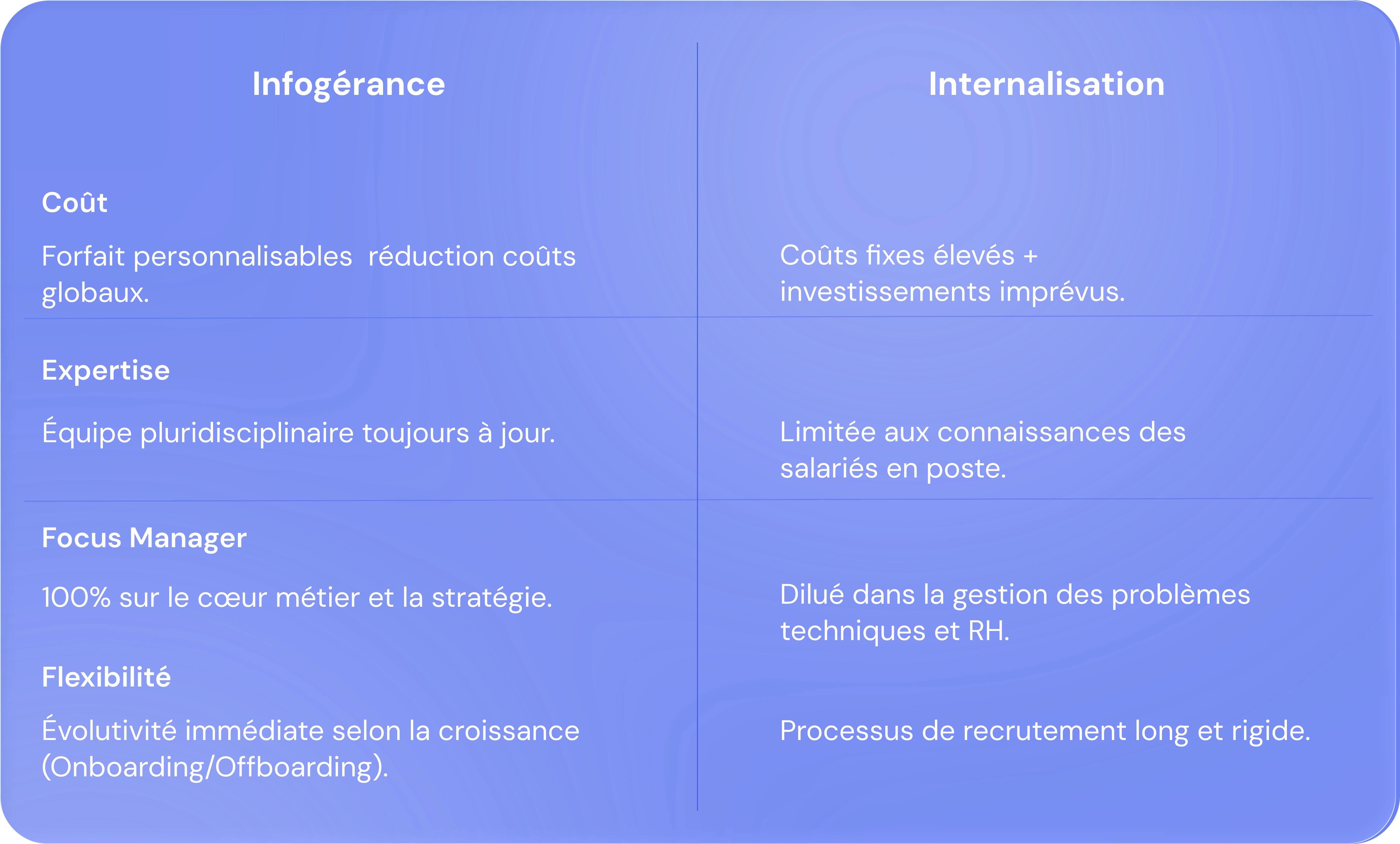
Comparative table: outsourcing or internalization?
How to choose between outsourcing and internalization? Our advice
The choice between outsourcing and internalization should be guided by a strategic analysis of your activity and your priorities.
• Define your core business: If your activity The main one is not computer science, theoutsourcing is often the preferred solution to allow you to focus on your core business.
• Evaluate criticality and confidentiality: If your information system Manage informations ultra-sensitive or is part of a public market highly regulated, theinternalization may be necessary for reasons of data security.
• Analyze the size of your business: For SMEs and VSEs, theoutsourcing is generally more economical than building a service IT internally complete. The big ones undertakings can opt for a hybrid approach (internalization of the strategic and outsourcing services for support and routine tasks).
• Consider the hybrid approach: THEinformation systems outsourcing does not have to be a binary choice. You can choose a delegated management for infrastructures (e.g.: cloud outsourcing) and keep the application development or management of the security in internally.
• Choose your provider carefully: If you opt for theoutsourcing, check the alignment of the provider with your requirements (SLA service level) and its skills specific (data security, technologies Cloud).
In conclusion, the best strategy is the one that maximizes the performance and safety of your information systems while optimizing your costs. For a lot ofundertakings, theoutsourcing is the growth driver that makes it possible to transform IT from a cost center into a real strategic asset.